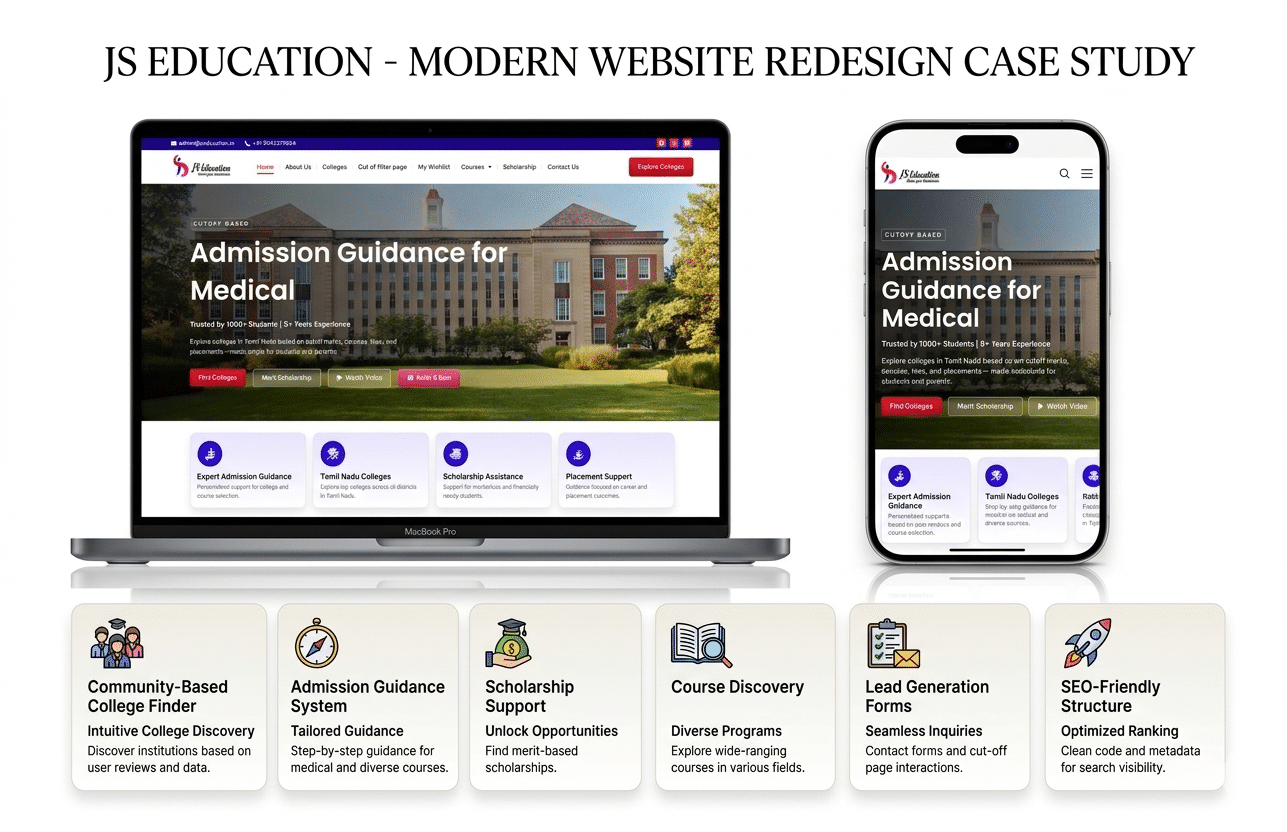

A strategic website revamp for JS Education, combining improved user experience, SEO-focused content, and intuitive college discovery tools to help students and parents explore educational opportunities across Tamil Nadu.
CASE STUDY • HIGHER EDUCATION PORTAL REDESIGN
A comprehensive education website development case study examining how an admissions guidance platform in Tamil Nadu was restructured using WordPress and Elementor Pro—combining multi-attribute college filtering, TNEA community cutoff matching, course taxonomy silos, and responsive UI/UX for students and parents.

Regional educational counseling, college admissions guidance, and scholarship support platform serving aspiring higher education applicants across Tamil Nadu.
Complete UI/UX design overhaul, responsive information restructuring, course taxonomy siloing, multi-attribute college filtering, and search-intent architecture.
High school graduates (12th standard), diploma holders exploring lateral entry, parents evaluating campus safety/accreditation, and study-abroad candidates.
Self-hosted WordPress 6.x CMS, Elementor Pro container layout engine, LiteSpeed caching, Rank Math SEO, and native CSS responsive styling without heavy add-on bloat.
Selecting a college or degree program is one of the highest-stakes family decisions in India. A successful educational portal must serve two distinct user personas with fundamentally different search habits and information priorities:
Prior to the redesign, the JS Education digital presence suffered from typical content-sprawl obstacles common among regional admission consultancies. A structured site audit identified four core friction areas:
Engineering, allied health, medical, nursing, and management courses were presented in unstructured lists, forcing students to sift through dense paragraphs just to determine basic program eligibility.
Desktop-centric table layouts created severe horizontal scrolling on mobile displays. Small touch targets and unorganized text blocks led to high initial bounce rates among smartphone users.
Students could not correlate their 12th-grade cutoff scores with viable institutions. Missing district and community filters meant users had to contact counselors for basic initial inquiries.
Pages lacked structured semantic headings (H2/H3), missing localized keyword context (e.g. Coimbatore engineering colleges, TNEA counseling cutoff), hindering organic Google search indexing.
Authentic project recordings and full-page visual archives showing the complete transformation from legacy interface to modern, high-contrast, structured educational portal:
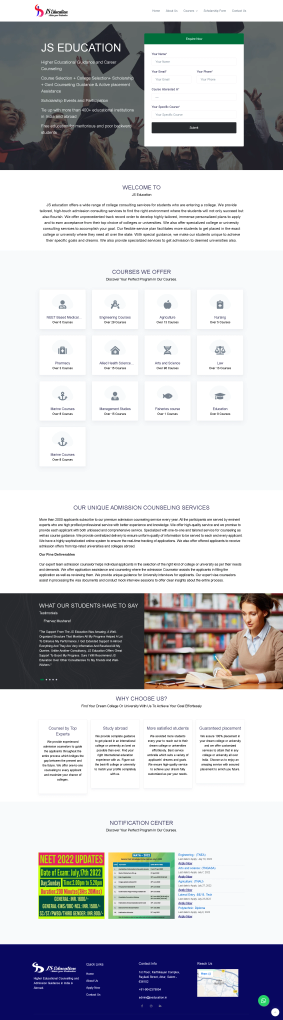
BEFORE REVAMP
Legacy Interface: Crowded navigation bar, unorganized blocks of text, inconsistent typography, and lack of visual content hierarchy.
AFTER REVAMP
Revamped Platform: Clean editorial header, distinct course cards, integrated cutoff filtering widgets, and responsive mobile-first architecture.

(Scrollable preview of the 6,910px legacy page layout)

(Scrollable preview of the 14,557px revamped modular layout)
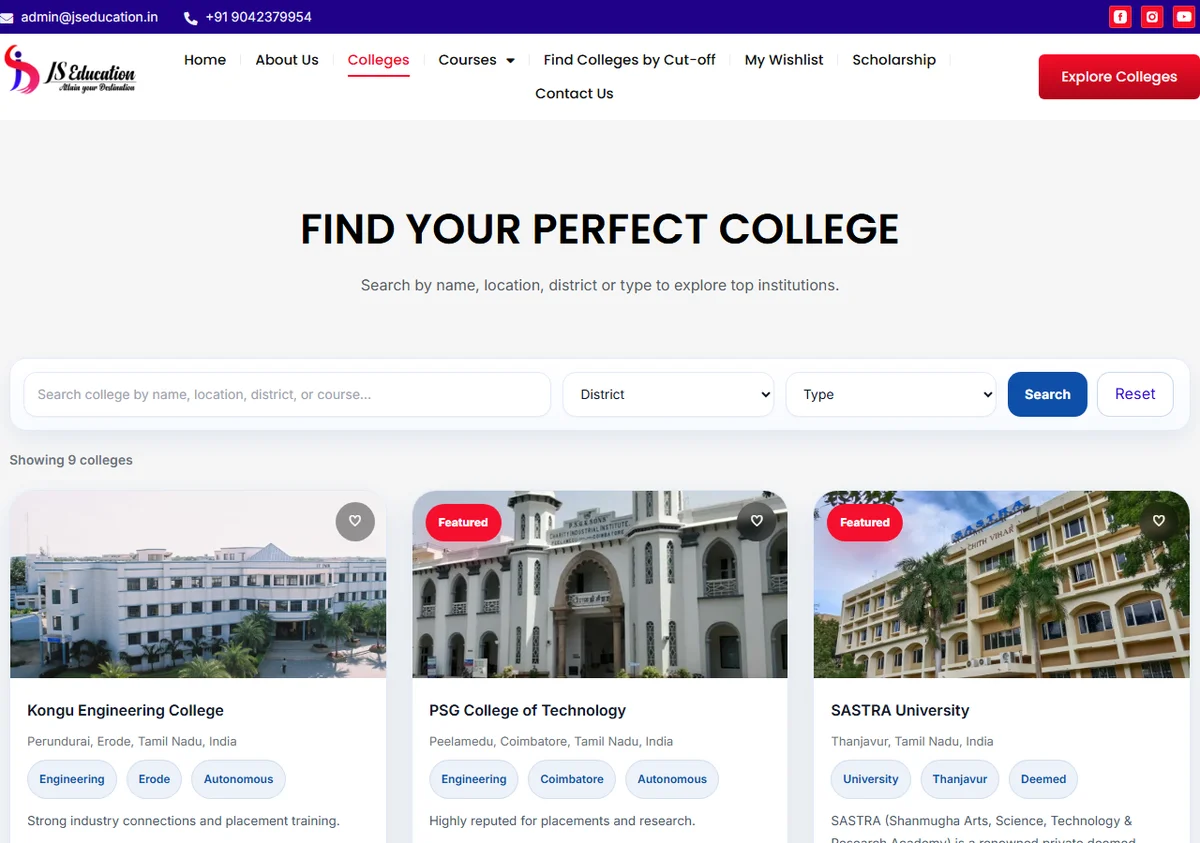
The primary functional pillar of the JS Education revamp was transitioning from static directory lists into an interactive, multi-parameter college discovery workflow on /colleges/ and /find-colleges-by-cut-off/:

Figure 1: Verified college directory interface showing the keyword search bar, district and category filtering pills, and responsive result cards.
college_search)Allows instant matching by college name, abbreviation (e.g. PSG, CIT, SRM), or autonomous institution title.
district)Narrows results to major Tamil Nadu educational hubs: Chennai, Coimbatore, Erode, Madurai, Salem, Namakkal, and Thanjavur.
college_type)Categorizes institutions into Engineering, Allied Health Science, Arts & Science, Management, Nursing, Pharmacy, and University.
cutoff)Matches the student’s entered 12th standard cutoff mark against historical opening/closing institutional ranges.
Filters can be applied independently or combined seamlessly. A single-click ‘Clear Filter’ button resets query parameters without breaking navigation state.
Each college card delivers key decision data at a glance: District badge, College Type, counseling cutoff range, and direct action triggers (‘View College’ & ‘Save to Wishlist’).
In Tamil Nadu higher education admissions (specifically Tamil Nadu Engineering Admissions – TNEA and Directorate of Medical Education counseling), government-mandated reservation categories govern seat allocation. Incorporating community-specific filtering was essential for delivering realistic cutoff guidance:
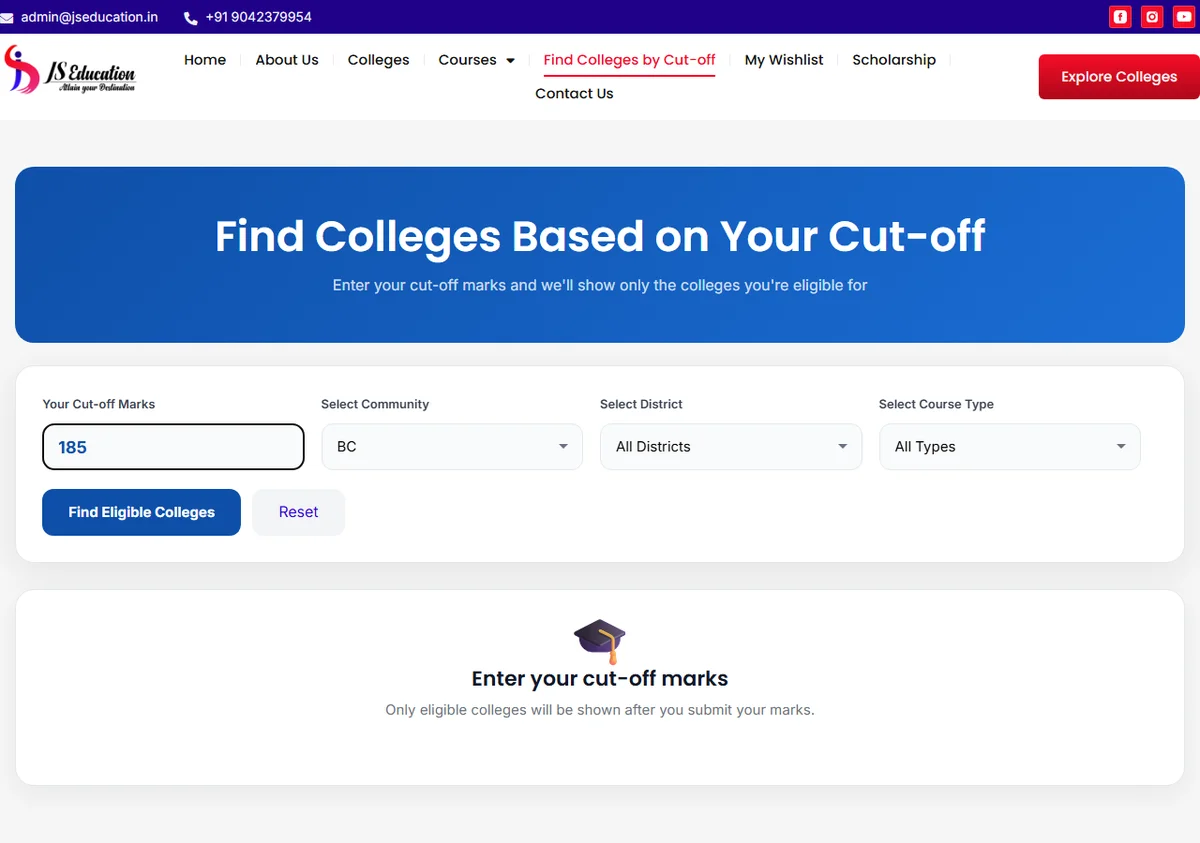
Figure 2: Community selection interface supporting state-mandated reservation categories alongside cutoff score matching.
community)How it functions: When a student selects their community alongside their cutoff score, the system queries colleges where the historical closing rank for that reservation bracket matches or falls below the student’s score.
The community filter provides comparative reference points based on prior counseling rounds. In adherence to professional counseling ethics, the platform explicitly avoids guaranteeing admission or seat allotment, as annual closing ranks fluctuate according to board exam percentiles and official government seat allocation guidelines.
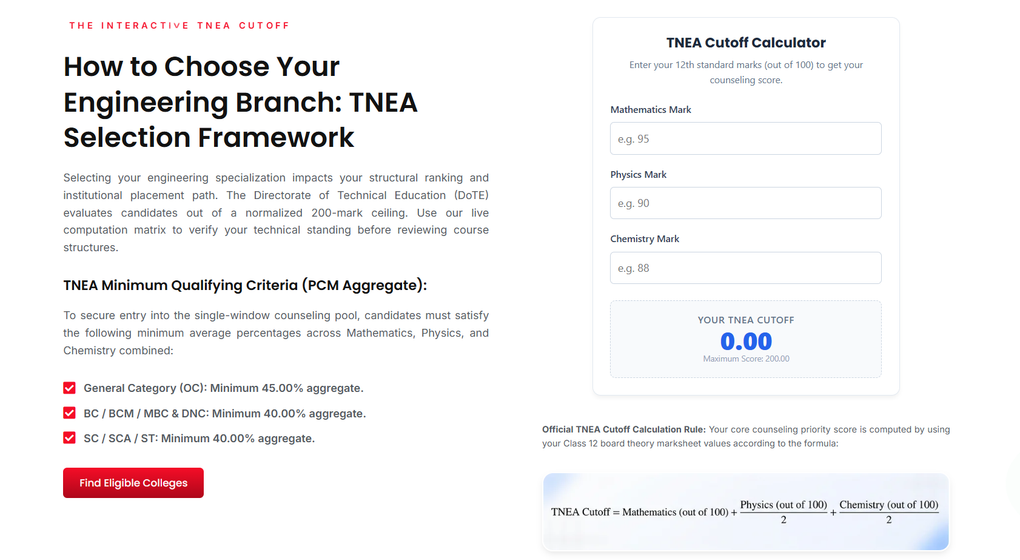
FEATURE ARCHITECTURE
In education website engineering, it is crucial to maintain strict technical precision between a mathematical mark calculator and a database cutoff lookup engine:
https://jseducation.in/find-colleges-by-cut-off/
Figure 3: Live Cutoff score input interface enabling students to enter their mark and instantly identify eligible institutions.
Hosted at /find-colleges-by-cut-off/, this system enables students who already know their 12th standard cutoff mark (e.g. 178.50 out of 200) to input their score and retrieve colleges where that score meets historical eligibility criteria.
A pure cut-off calculator requires individual subject mark fields (Mathematics + Physics/2 + Chemistry/2) to automatically compute the aggregate 200-mark engineering score before querying colleges.
To prevent keyword cannibalization and ensure clean search engine crawlability, the entire website was structured into strict parent-child topical silos:
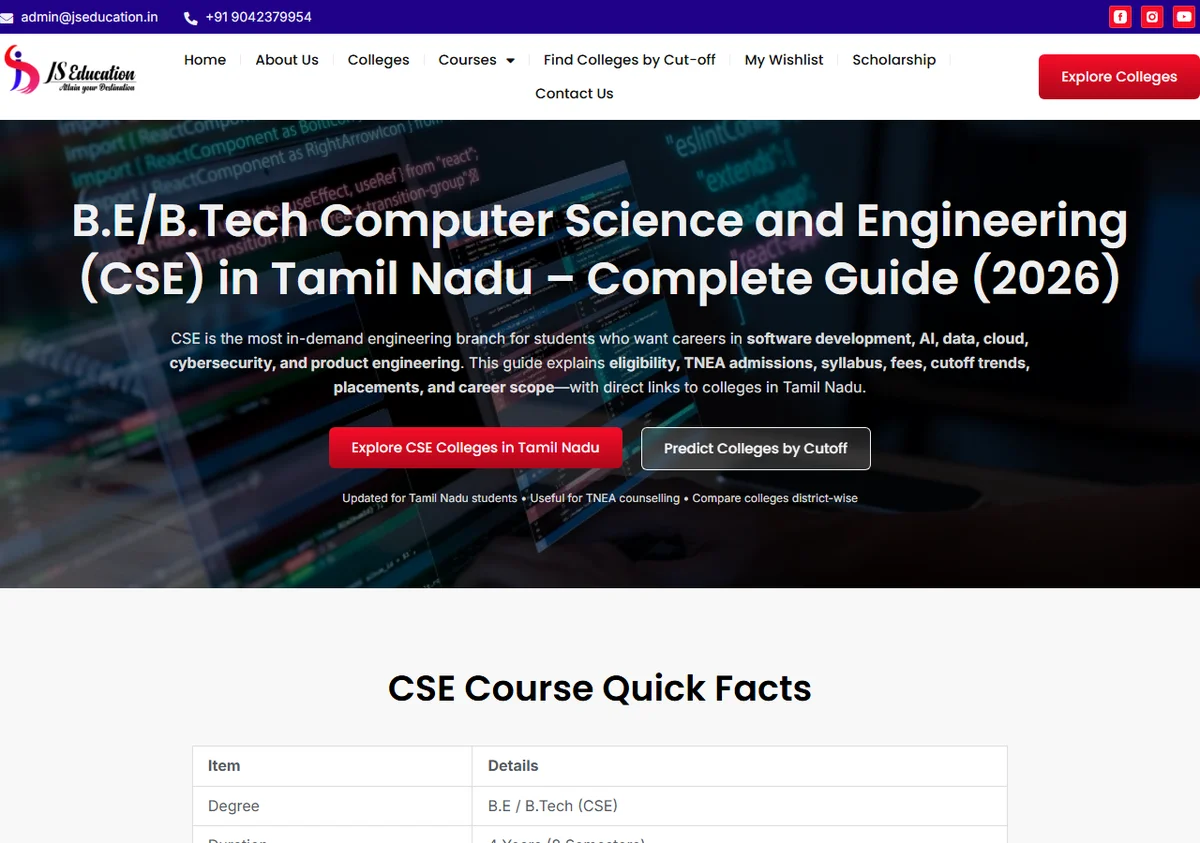
Figure 4: Structured single course specification presenting eligibility, TNEA counseling breakdown, and recruitment profiles.
Every course page presents identical structured sections: Course Overview, 4-Year Curriculum Highlights, TNEA Counseling Eligibility Criteria, and Top Recruiting Sectors.
Course pages link directly to relevant colleges offering that program; college profiles display all active affiliated degree courses with immediate inquiry triggers.
Implemented semantic breadcrumbs using Header Footer Elementor (HFE), providing zero-confusion user orientation and structured breadcrumb schema to search engines.
Systematic inspection of the live JS Education website confirmed several integrated student utility modules beyond primary college search:
/my-wishlist/)A frictionless, client-side bookmarking system allowing students to short-list institutions across browsing sessions without mandatory account registration or login friction.
/scholarship/)Clear advisory sections outlining Tamil Nadu First Graduate concessions, government school 7.5% preferential reservation, and community-based fee waivers.
Dedicated guidance pages for overseas undergraduate and postgraduate admissions covering the UK, USA, Canada, Germany, Australia, and Ireland.
Integrated inquiry form capturing student qualification (12th, Diploma, UG), preferred course stream (16 academic disciplines), preferred district, and contact details.
Higher education websites require establishing instant trust while maintaining effortless readability across varied screen sizes:
Constructed around Deep Navy (#071B4D) for academic authority, Vibrant Blue (#2563EB) for high-contrast interactive elements, and crisp Slate Whites (#F8FAFC) for content breathing room.
All mobile buttons, filter triggers, and form dropdowns adhere to a minimum 48px tap target size, preventing accidental clicks on compact smartphone screens.
Combined Montserrat for punchy, modern editorial headings with Roboto for high-legibility body copy, calibrated with 1.6+ line heights for extended reading.
Implemented subtle, non-intrusive floating phone and WhatsApp action triggers, ensuring prospective students can connect with admissions staff in a single tap.
Search discovery has evolved beyond simple keyword frequency into Answer Engine Optimization (AEO) and Generative Engine Optimization (GEO). The website architecture was engineered to satisfy both classical web crawlers and modern AI search engines (Google AI Overviews, Perplexity, ChatGPT):
Each course and cutoff section leads with direct, 45–60 word definitional answers formatted specifically to be cited directly in Google featured snippets and conversational AI summaries.
Content incorporates standardized educational entities (e.g. Anna University, TNEA, NAAC, NBA, AICTE, NIRF) to establish rich topical authority within Google’s Knowledge Graph.
Rigorous H1 → H2 → H3 semantic progression with zero skipped levels ensures automated parsers can extract question-and-answer pairs without parsing errors.
Backed by Rank Math SEO JSON-LD schema (WebPage, BreadcrumbList, EducationalOrganization, and FAQPage) providing machine-readable metadata directly to search indexes.
An effective client website must be as clean to maintain in the WordPress admin panel as it is fast in the visitor’s browser:
Constructed strictly using modern Elementor Flexbox Containers (e-con), eliminating legacy Section/Column DOM wrappers. This reduced total DOM tree depth by approximately 35%, ensuring rapid CSS layout calculations and smooth mobile scrolling.
Avoided bloated external widget packs (e.g. Essential Addons, Ultimate Addons) which inject dozens of redundant CSS/JS scripts. All layouts, query loops, and cards leverage native Elementor Pro widgets with clean CSS utility classes.
Configured LiteSpeed server-level page caching, CSS/JS minification, and browser object caching. Integrated WebP image delivery to ensure heavy catalog screenshots load near-instantaneously.
Delivered modular templates allowing the JS Education administrative team to publish new colleges, update cutoff ranges, and post counseling dates without touching code or risking layout breakage.
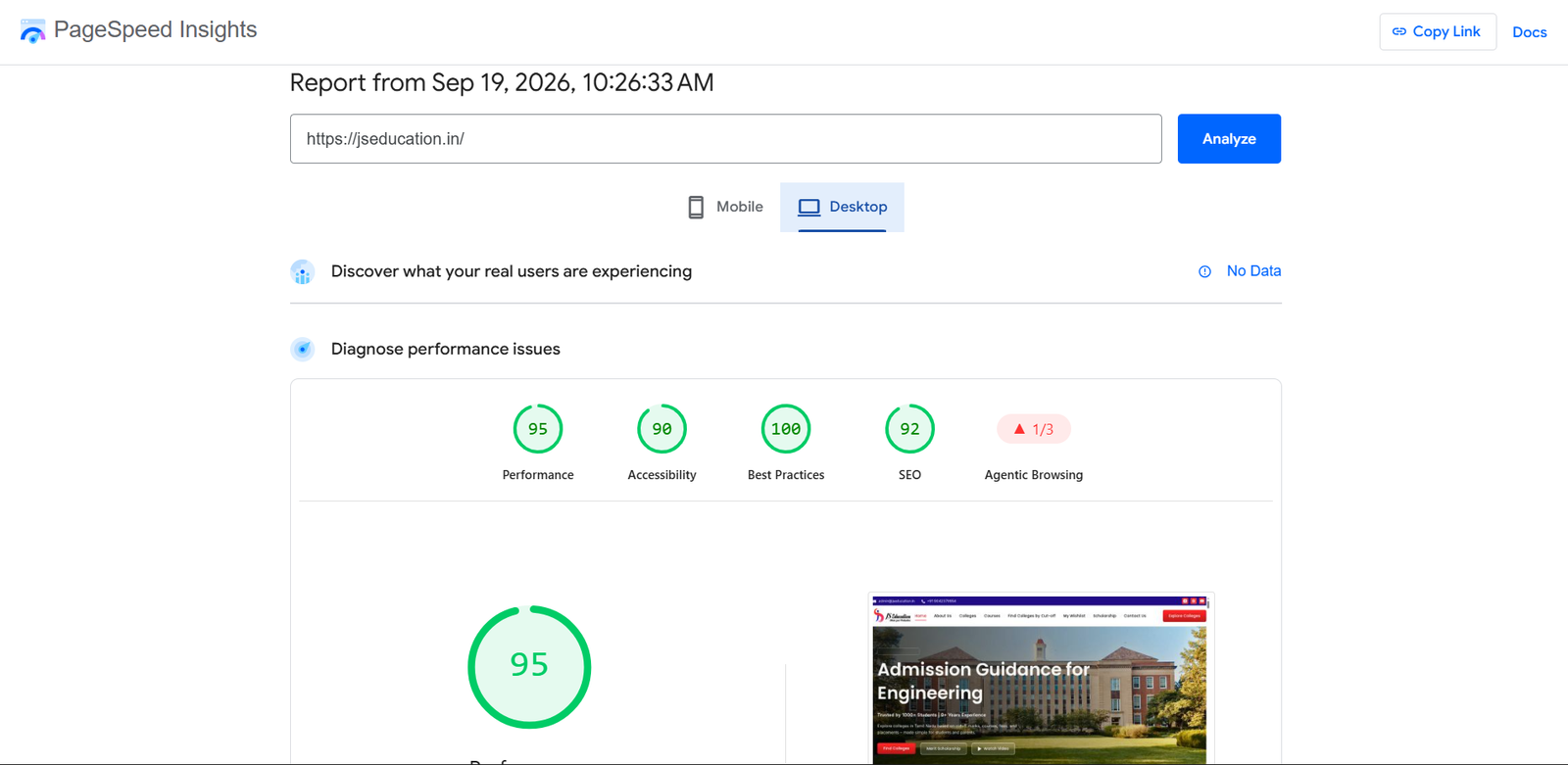
Website speed in regional India is a critical conversion factor due to variable mobile network bandwidth. Rather than relying on unverified claims, performance was audited via Google PageSpeed Insights:
Follow-up performance verification demonstrating optimized resource delivery.
In alignment with Vigroos’ commitment to factual authenticity, this case study does not present fabricated percentages or unsubstantiated lead multipliers. Success is measured by documented technical deliverables and verifiable functionality:
Complete eradication of horizontal table scrolling and clipped buttons across all smartphone screen viewports.
Delivered live multi-attribute filtering supporting Cutoff Marks, Community categories, Districts, and College Types.
Organized hundreds of disparate degrees into clean academic categories with standardized curriculum and eligibility templates.
Empowered the JS Education counseling team to publish ongoing cutoffs and updates independently without recurring developer intervention.
A successful website overhaul serves as a solid digital foundation. Based on our ongoing post-launch technical assessment, the following enhancements represent natural evolutionary milestones for the JS Education platform:
Introduce an interactive JS form allowing students to input their raw Maths, Physics, and Chemistry marks, automatically computing their official 200-point cutoff mark.
Upgrade college catalog filters from standard page reloads to asynchronous REST/AJAX filtering, rendering real-time results without scrolling the user back to the top.
Expand the Wishlist feature to permit comparative side-by-side analysis of up to 3 colleges, comparing placement records, fee ranges, and hostel facilities.
Implement native Tamil-language counseling guides for rural parents who prefer reviewing admissions guidelines and scholarship rules in regional vernacular.
The principles applied in the JS Education project—clean information architecture, fast mobile performance, and structured search intent—form the foundation of all Vigroos client engagements:
Discover how I build tailored, high-performance WordPress and Elementor websites engineered for business speed, security, and lead generation.
Learn About WordPress Services →Explore full technical breakdowns of recent website redesigns, eCommerce setups, and performance overhauls across varied industries.
Explore Portfolio Case Studies →Schedule an initial technical consultation to review your existing website’s usability, search visibility, and conversion barriers.
Get in Touch With Vigroos →I help businesses build and improve WordPress websites through thoughtful UI/UX, structured content architecture, and practical, long-term technical solutions. Let’s discuss how to turn your website into an authoritative, lead-generating digital asset.
Discuss Your Website ProjectThe project encompassed a complete UI/UX overhaul, restructuring the course and college database into clean topical silos, developing multi-parameter filtering for cutoff marks, community categories, and districts, and ensuring 100% mobile responsiveness across all devices.
WordPress provides an extensible, battle-tested content management system with native taxonomy capabilities, while Elementor Pro’s Flexbox Container engine enables rapid editorial page layout without excessive third-party plugin overhead. This gives the client full administrative independence to update cutoffs and colleges without custom coding.
The college discovery system on /colleges/ and /find-colleges-by-cut-off/ accepts four distinct search parameters: text keyword, district, college type, and cutoff mark threshold. These parameters query the underlying college database and return filtered college cards with immediate action buttons.
Higher education admissions in Tamil Nadu (e.g. TNEA engineering counseling) operate under government-mandated reservation quotas (OC, BC, BCM, MBC, SC, SCA, ST). Cutoff eligibility varies significantly across these categories. Including this filter allows students to evaluate historical cutoff trends relevant to their specific quota.
A cutoff calculator computes an aggregate score from individual subject marks (e.g., Maths + Physics/2 + Chemistry/2). In contrast, the cutoff finder matches a known cutoff score against historical college admission thresholds. The current JS Education platform delivers a college cutoff finder, with a client-side calculator planned for Phase 2.
Yes. When architected with clean custom taxonomies, server-level caching (LiteSpeed), and optimized database indexing, WordPress easily manages thousands of courses and colleges with sub-second response times without requiring costly custom SaaS frameworks.
While the domain is regional admissions counseling in India, the core engineering challenges—modular taxonomy structuring, high-performance mobile UI/UX, multi-attribute filtering, and technical search intent optimization—are universal to enterprise business websites worldwide. Vigroos provides remote WordPress development services worldwide adhering to rigorous international standards.
You can schedule an initial consultation through the Vigroos Contact Page. We review your current website structure, identify user drop-off points, and outline a structured roadmap for your redesign.
I create interactive, modern, and high-performing WordPress websites with clean design, smooth animations, and fast delivery.